

Published: February 2024 | Last Updated: May 2026
The 7 strengthened Aged Care Quality Standards are the national standards that aged care providers in Australia must follow to deliver safe, respectful and high-quality care. Introduced under the Aged Care Act 2024 and implemented from 1 November 2025, they replaced the previous 8 standards and place greater focus on dignity, clinical care, nutrition, independence and safety.
The standards apply to most government-funded aged care providers across residential aged care, home care and support services. For families choosing care, they provide a framework for understanding what good aged care should actually look like in practice.
In 2021, the Royal Commission into Aged Care Quality and Safety recommended strengthening Australia’s aged care laws and quality requirements to better protect older Australians and improve accountability across the sector.
The 7 strengthened standards are:
- The Individual
- The Organisation
- The Care and Services
- The Environment
- Clinical Care
- Food and Nutrition
- The Residential Community
Table of Contents
- What Changed Between the Old 8 Standards and the New 7 Standards?
- Why Were the Aged Care Quality Standards Strengthened?
- When Did the New Aged Care Standards Start?
- What Are the 7 Strengthened Aged Care Quality Standards?
- What Do the New Aged Care Standards Mean for Families And Executors?
- What Is the Code of Conduct in Aged Care?
- What’s the Difference Between the Aged Care Code of Conduct and the Quality Standards?
- What’s the Difference Between Aged Care Standards and Accreditation?
- FAQs – Aged Care Quality Standards
What Changed Between the Old 8 Standards and the New 7 Standards?
The strengthened 7 Aged Care Quality Standards replaced the previous 8 standards that operated under the earlier aged care framework. The change was part of a broader reform following the Royal Commission into Aged Care Quality and Safety and the introduction of the Aged Care Act 2024.
For families, the main point is simple: the current standards place stronger emphasis on rights, dignity, clinical care, nutrition, independence, provider accountability and the everyday experience of older people receiving care.
| Old Framework | New Framework |
| 8 Aged Care Quality Standards | 7 strengthened Aged Care Quality Standards |
| Applied under the previous aged care framework | Applies under the Aged Care Act 2024 framework |
| Focused on quality and safety expectations | Adds stronger focus on rights, clinical care, food, nutrition and daily life |
| Used before the strengthened standards commenced | Commenced from 1 November 2025 |
Why Were the Aged Care Quality Standards Strengthened?
The Aged Care Quality Standards were strengthened to improve safety, dignity, accountability and consistency across aged care in Australia. The reforms followed serious concerns raised by the Royal Commission into Aged Care Quality and Safety, including poor care, weak accountability, food and nutrition, clinical governance, and the need for older people to have stronger rights in care.
The strengthened standards set clearer expectations for aged care providers. They explain what safe and respectful care should look like, whether a person receives support at home or lives in residential aged care.
For families, the standards are useful because they turn broad ideas like “good care” into practical expectations. They can help families ask better questions, compare providers and recognise when care may not be meeting an acceptable standard.
What this means for families:
- Providers should be able to explain how they personalise care, manage risk and support independence.
- Families should expect clear communication, safe environments, respectful treatment and proper clinical oversight.
- Concerns about care should be taken seriously and handled through clear feedback and complaints processes.
When Did the New Aged Care Standards Start?
The current strengthened Aged Care Quality Standards started from 1 November 2025, alongside the broader Aged Care Act 2024 reforms.
Key timeline:
- 2019: The first Aged Care Quality Standards replaced older accreditation rules.
- 2021: The Royal Commission into Aged Care Quality and Safety recommended major reform.
- 2024: The Aged Care Act 2024 became the foundation for the reformed aged care system.
- 1 November 2025: The 7 strengthened Aged Care Quality Standards came into effect.
What Are the 7 Strengthened Aged Care Quality Standards?
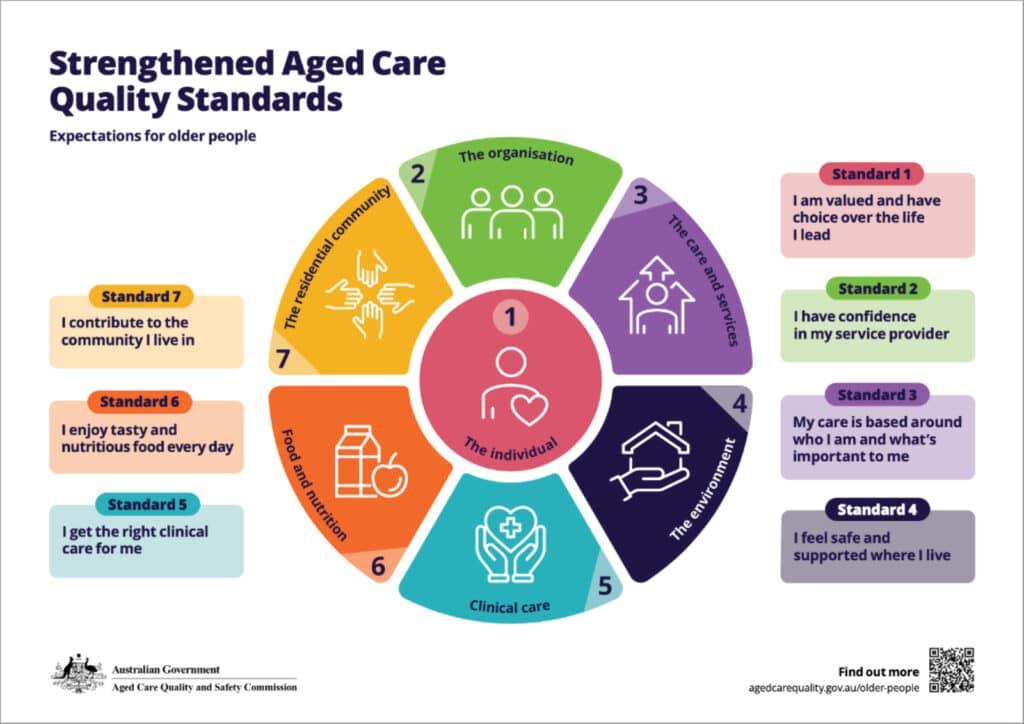
A summary of the Aged Care Quality Standards. Image from Aged Care Quality
The 7 strengthened Aged Care Quality Standards explain what good aged care should look like in practice. They cover the rights and needs of the individual, how providers are governed, the quality of care and services, the safety of the environment, clinical care, food and nutrition, and life within a residential community.
The standards apply differently depending on the type of aged care service, but together they create a clearer benchmark for safe, respectful and person-centred care.
| Standard | Main Focus |
| 1. The Individual | Rights, dignity, independence, culture, choice and control |
| 2. The Organisation | Governance, workforce capability, feedback and accountability |
| 3. The Care and Services | Safe, effective and personalised care planning |
| 4. The Environment | Clean, safe, comfortable and accessible care settings |
| 5. Clinical Care | Safe, evidence-based and coordinated clinical support |
| 6. Food and Nutrition | Nutritious food, hydration, choice and dining experience |
| 7. The Residential Community | Social connection, relationships, activities and secure accommodation |
1. The Individual
“You have the right to be treated with dignity and respect, and to live free from any form of discrimination. You make decisions about your care and services, with active support when you want or need it. Your aged care provider must understand your rights, needs, goals, preferences, cultures and beliefs and your need for dignity of risk, independence, choice and control around individual decisions. Your provider understands who you are and what is important to you, and this determines the way your care and services are delivered.” Fact Sheet: Standard 1.
How this looks in practice: An older person who still loves gardening but has mobility challenges is supported rather than restricted. A good provider would make small changes, like adding raised garden beds or extra supports, so they can keep gardening safely and maintain their independence.
What families should look for:
- Staff know the person’s preferences, routines, culture and goals.
- The older person is supported to make choices, even where some risk is involved.
- Care feels personal, not like the same routine applied to every resident.
2. The Organisation
“The organisation that provides your care is well run. This includes your governing body, which is responsible for delivering quality care and services, setting strategic priorities, promoting a culture of safety and driving improvement. You can contribute to improvements to your care services. Your provider and workers listen and respond to your feedback and concerns. You get care from workers who are knowledgeable, competent, capable and caring.” Fact sheet: Standard 2.
How this looks in practice: An aged care provider conducts regular staff training, audits care quality, investigates complaints and improves processes.
What families should look for:
- Clear communication from managers and care teams.
- Staff who appear trained, supported and consistent.
- A provider that explains how feedback and complaints lead to real improvements.
3. The Care and Services
“The care you get is safe and effective. It optimises your quality of life, including through maximising independence and reablement. Your care meets your current needs, goals and preferences. Assessment and planning processes are well planned and coordinated, and involve ongoing communication with you, your supporters and aged care workers. Your right to take risks is respected.” Fact Sheet: Standard 3.
How this looks in practice: A resident recovering from a fall receives a personalised physiotherapy plan, mobility support, and regular reassessment.
What families should look for:
- Care plans that are reviewed as needs change.
- Support that encourages independence rather than unnecessary restriction.
4. The Environment
“You feel safe when using aged care services, whether in your own home or in an aged care home. The equipment used is safe, appropriate and well-maintained. Precautions are taken to stop the spread of infections. When receiving care not in your home, the environment is clean, safe and comfortable and supports your sense of belonging, social connection and function. You can move around freely.” Fact sheet: Standard 4.
How this looks in practice: An aged care home installs handrails and non-slip flooring, but it also goes further—using clear signage to help people living with dementia move around more confidently, and creating outdoor spaces that are safe, easy to access, and still enjoyable to spend time in.
What families should look for:
- Clean, safe and well-maintained rooms, bathrooms and shared spaces.
- Equipment that appears suitable and properly maintained.
- Design features that support mobility, dementia care, comfort and social connection.
5. Clinical Care
“You get safe, and quality clinical care services that are person-centred, evidence-based, effective, coordinated and continuously improved. It is delivered by registered health practitioners, allied health professionals, allied health assistants and competent workers. The care meets your changing clinical needs, supports your goals and preferences and enhances independence and quality of life.” Fact sheet: Standard 5.
How this looks in practice: A resident with diabetes receives monitored blood sugar levels, medication management, and coordinated GP and nursing care.
What families should look for:
- Clear medication management and clinical monitoring processes.
- Access to registered health practitioners and allied health support where needed.
- Staff who can explain how clinical changes are identified and escalated.
6. Food and Nutrition
“You get plenty of food and drink that you enjoy. The food and drinks served at your aged care home are nutritious, appetising and safe, and meet your needs and preferences. The dining experience is enjoyable, includes variety, supports a sense of belonging, social engagement, function and quality of life. Food must support both health and enjoyment.” Fact sheet: Standard 6.
How this looks in practice: A resident with cultural dietary needs is served meals that reflect their background, has a say in what’s on the menu, and is gently supported to make sure they’re eating and drinking enough.
What families should look for:
- Meals that are appealing, varied and suitable for dietary needs.
- Support for hydration and eating where needed.
- Dining spaces that feel calm, social and respectful rather than rushed.
7. The Residential Community
“You are supported to do the things you want and enjoy. You are helped to maintain your relationships and connections with your community. You experience well-planned and coordinated transitions in and out of care. You are confident in the security of your accommodation.” Fact sheet: Standard 7.
How this looks in practice: A facility organises social activities and events, encourages family visits, and supports friendships between residents.
What families should look for:
- Opportunities for residents to maintain friendships, hobbies and community ties.
- Support for family visits and meaningful activities.
- A sense that the residence is a home, not only a clinical care setting.
What Do the New Aged Care Standards Mean for Families And Executors?
For families, the new aged care standards are not just compliance language. They are a practical way to judge whether a provider is likely to deliver safe, respectful and personalised care.
When comparing aged care providers, ask questions such as:
- How do you personalise care plans for each resident?
- What clinical support is available, and how are changes in health managed?
- How do you support nutrition, hydration and enjoyable meals?
- How do you help residents maintain independence, routines and social connections?
- How are complaints handled, and how do families receive updates?
Here’s a guide to additional questions to ask aged care providers.
It is also worth thinking about what happens outside the care decision itself. Moving into aged care can involve downsizing, preparing a home, sorting belongings, managing emotional family decisions or supporting an executor through a property transition.
Complete Property Clearance helps families manage these transitions with respectful property clearance, preparation and support services designed to reduce stress during a difficult period. If you need help preparing a home during an aged care transition, learn more about our transition-to-long-term-care support services.
What is the Code of Conduct in Aged Care?
The Aged Care Code of Conduct explains how registered aged care providers, responsible persons and aged care workers must behave when delivering funded aged care services. It focuses on behaviour, respect, safety, honesty and the way older people are treated in day-to-day care.
In simple terms, the Quality Standards describe what providers must deliver. The Code of Conduct describes how people and organisations must behave while delivering that care.
What’s the Difference Between the Aged Care Code of Conduct and the Quality Standards?
The Aged Care Quality Standards and the Aged Care Code of Conduct work together, but they do different jobs. The standards define the level of care providers must deliver. The Code of Conduct explains how workers, responsible persons and providers must behave when delivering that care.
| Area | Quality Strandards | Code of Conduct |
| Main purpose | Defines what good aged care must include. | Defines expected behaviour in aged care. |
| Focus | Systems, care quality, safety and outcomes. | Conduct, respect, honesty and safe behaviour. |
| Applies to | Registered providers and relevant aged care services. | Providers, responsible persons and aged care workers. |
| Useful for families because | It helps compare whether care meets expected standards. | It helps identify whether people are being treated appropriately. |
What’s the Difference Between Aged Care Standards and Accreditation?
Aged care standards and accreditation are related, but they are not the same thing. The Aged Care Quality Standards describe the level of care providers are expected to deliver. Accreditation is part of the process used to assess whether a provider is meeting relevant standards and regulatory expectations.
| Term | Meaning | Why it matters |
| Aged Care Quality Standards | The expected level of care, safety, dignity and service quality. | Helps families understand what good care should look like. |
| Accreditation | An assessment process is used to check provider performance. | Helps regulators monitor whether providers are meeting expectations. |
| Compliance monitoring | Ongoing supervision, audits, checks and complaints processes. | Helps identify and respond to risks in care quality. |
If you’re feeling overwhelmed managing a property during this time, you don’t have to handle it alone. Our team can take care of the entire clearance process with care, discretion, and respect, so you can focus on what matters most. Get in touch today for a confidential, no-obligation quote.
FAQs – Aged Care Quality Standards
Aged care providers implement the standards through care planning, staff training, governance systems, feedback processes and day-to-day service delivery. The standards should shape how care is planned, delivered, reviewed and improved.
The Aged Care Quality and Safety Commission monitors providers through audits, performance checks, complaints, site visits and regulatory supervision. Monitoring can happen through planned reviews or in response to specific concerns.
Raise the issue with the provider first if it is safe to do so. If the concern is not resolved, or if someone may be at risk, contact the Aged Care Quality and Safety Commission or seek help from an aged care advocacy service.
The Aged Care Quality and Safety Commission reviews complaints through assessments, investigations and provider monitoring. Depending on the seriousness of the issue, providers may receive warnings, sanctions, increased supervision or lose accreditation. Families can also escalate urgent concerns or seek support through aged care advocacy services.
The standards apply to most government-funded aged care providers in Australia, including residential aged care, home care and Commonwealth Home Support Programme services. Some privately funded services, retirement villages and non-aged-care health services may sit outside the full framework. If you are unsure, check whether the provider is registered or regulated by the Aged Care Quality and Safety Commission.
Families should ask about staffing, clinical care, food quality, communication, social activities and how care plans are personalised. It is also useful to ask how complaints are handled, how often care plans are reviewed and how families are kept informed.
About the Author
Connect with Jude: LinkedIn
This article was written by Jude Morton, an experienced property professional specialising in styling, management, and renovation. With qualifications as a Property Manager, Real Estate Agent, and Buyer’s Agent, Jude has managed high-value properties and brings practical, real-world insight to preparing homes for sale.
Disclaimer
This article is intended to provide general information and guidance around aged care standards and family transitions. Decisions involving aged care can be emotional and complex, and individual circumstances may vary. Where needed, professional medical, legal, or financial advice should be sought.
Trusted Sources
The information in this guide is supported by current government and regulatory guidance, including:
- Understanding the Aged Care Quality Standards: Learn what the Aged Care Quality Standards mean for you or your loved one.
- How Aged Care Quality Standards Are Applied in Care Homes: Understand how standards affect everyday care and services.
- What Good Quality Aged Care Should Look Like: Learn what to expect from safe, respectful, and supportive care.
- Why the Aged Care Quality Standards Were Strengthened: Find out what changed and why it matters for residents and families.
- How Aged Care Quality Is Monitored in Australia: See how safety and quality in aged care services are measured.
- Aged Care Quality and Safety Commission website: Choice, dignity, respect – your rights in aged care
- Royal Commission article: Aged Care Quality and Safety